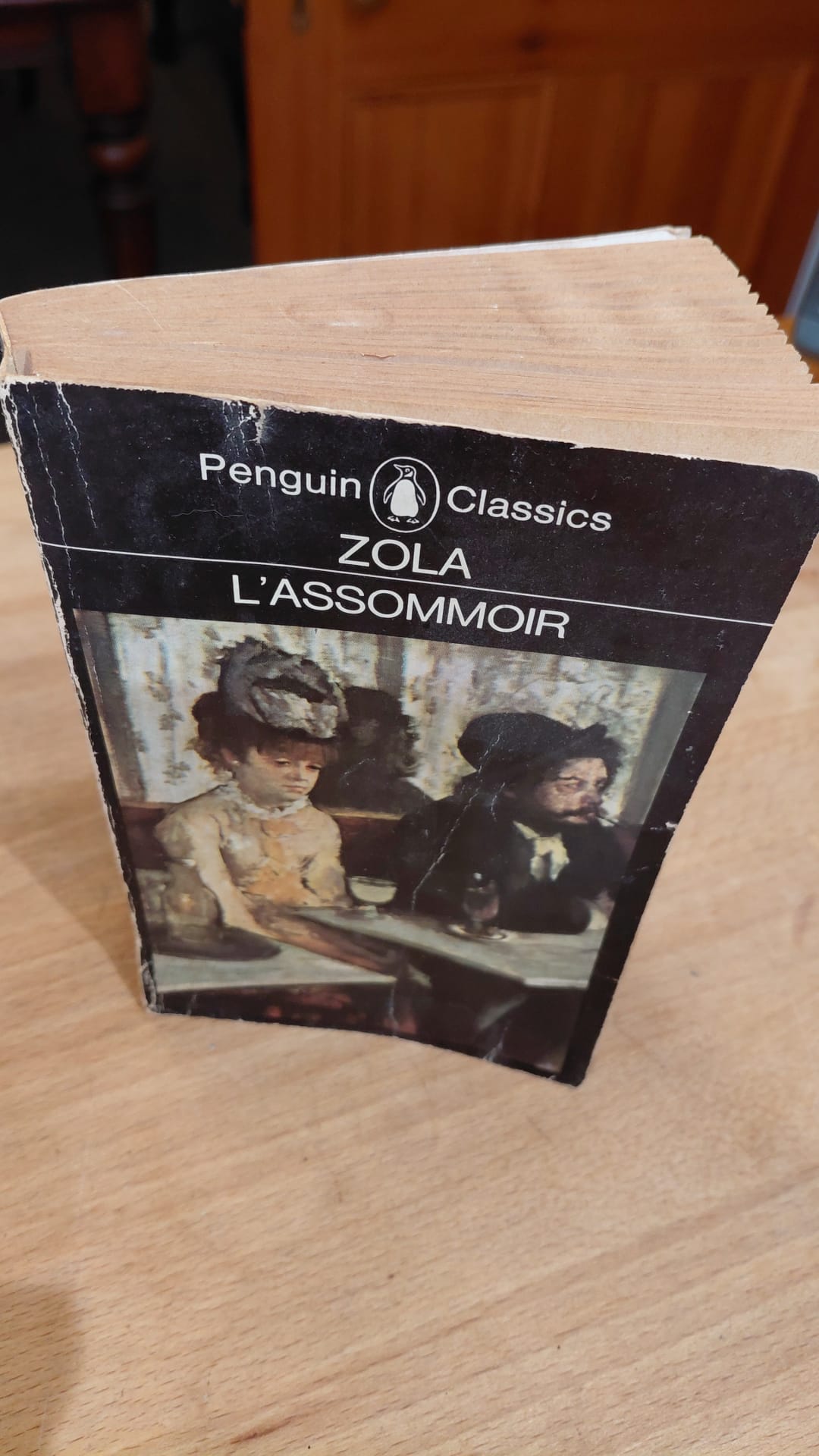
Author - Émile Zola
Year of Publication - 1877
To my mind, there are few other novels which so effectively epitomise the somber reality of life amongst the demi-monde as Emile Zola’s 1877 l’Assommoir.
Although only one of a series of novels recounting the history of the fictional Rougon-Maquart dynasty in C19th France, this stands alone as a masterpiece of observation, and while Zola exhibits an element of sympathy for the beleaguered Gervaise, he does not shy away from acknowledging her shortcomings and her own part in her eventual downfall. Zola has an unerring ability to vividly transport the reader to the back streets of Paris. The descriptions of living conditions, expressed as something of fact rather than in a way to provoke outrage, are wonderfully drawn and even in the context of slum conditions which have more recently existed in areas which we ourselves are aware of, are chilling in the way these people accepted their sad lot as their only expectation in life.
Gervaise’s attempt to lift herself and her little family out of the gutter, whilst admirable, was always doomed to failure. We knew that she had nothing and no-one on her side and her valiant efforts were no match for her naivety and her vulnerability to exploitation by others. The title of the book is variously translated as The Drunkards, The Gin Palace, the Dram Shop and others, but it is the one of the series which generally retains Zola’s original title as it has no precise equivalent in English. Drink, and the potential evils thereof, are a pivotal theme running through the story although its excess does not entirely define Gervaise as a person until the latter stages of her life.
Gervaise is the ultimate anti-heroine. She fights against the odds to provide a decent life for her children but in the end succumbs to her experience as a downtrodden, neglected and abused wife; a woman who could have lived a fulfilled and happy life had she not been a naïve, innocent but basically decent woman who had little chance of breaking out of her deprived and abusive background. Both her sons are portrayed in subsequent novels in the series, as is her infamous and appalling daughter, Nana, the eponymous subject of a further title in the series.
This is one story which will stay with me for many reasons. Unlike too many great novels that are impelling reading but subsequently disappoint at the denouement, nothing is more telling, and more heartbreaking, than the very final, short paragraph, of the novel, spoken by her previous bete noir, Bibi-la-Galete.
Leave a comment
Have something to say about this article? We'd love to hear from you. Comments are reviewed before they appear on the site.