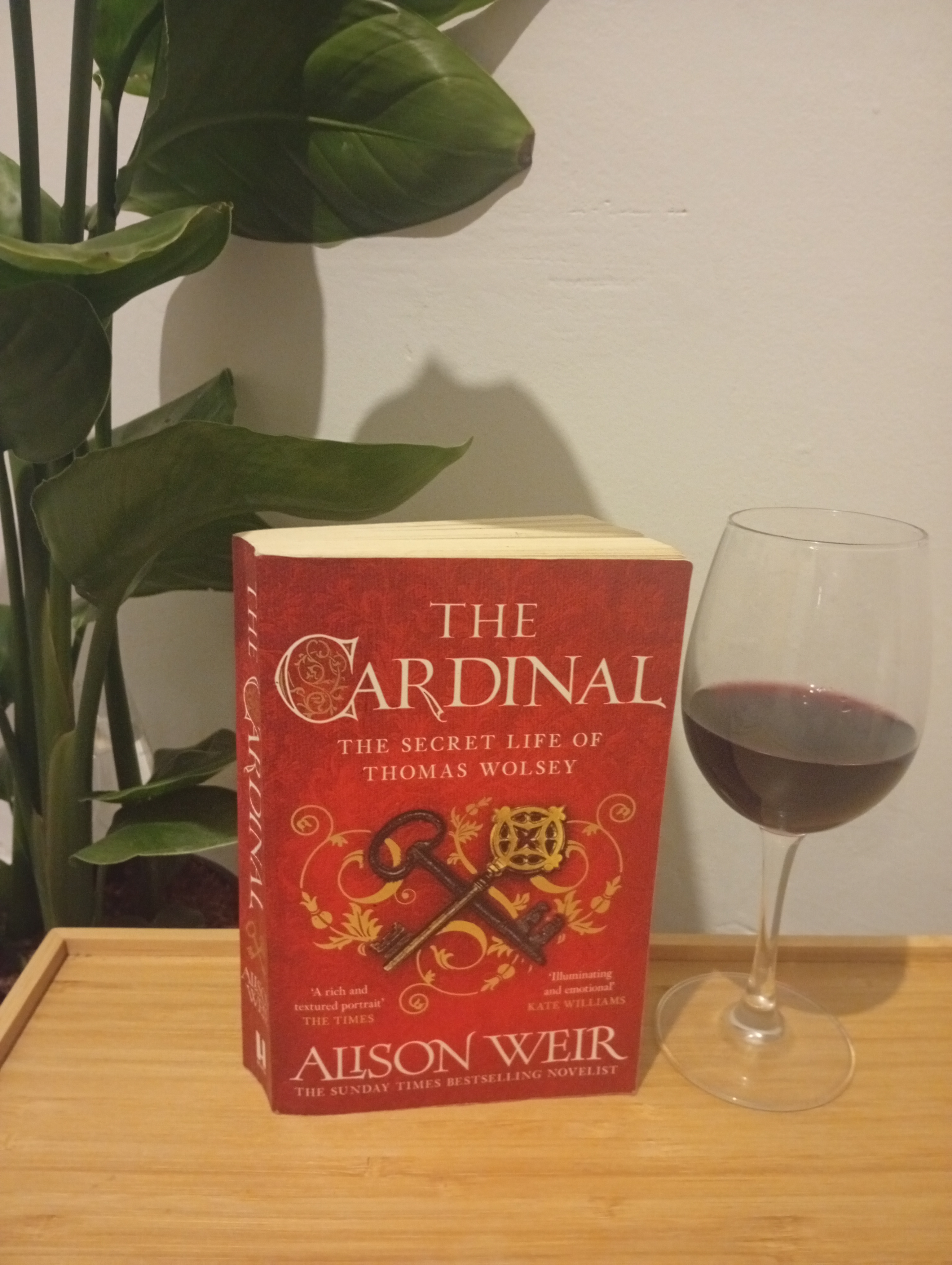
Author - Alison Weir
Publisher - Ballantine Books
Year of Publication - 2025
For my money, few periods in English history are as rich and scandalous as that of the Tudors. At school, at least during my tenure, the topic was boiled down to a quick review of the most salient characters and the hackneyed ‘Divorced, Beheaded, Died, Divorced, Beheaded, Survived’, and other such ol’ chestnuts. It wasn’t until well after leaving formal education that I started to learn more about the figures behind the clichés.
Naturally, a great deal of literature concerning this period deals with the monarchs themselves. The personal and political struggles of Henry VIII and his hard-done-by consorts, the triumphant and progressive reign of Elizabeth I, or the fraught and somewhat terrifying mandate of Mary I. However, for those who wish to dig a little deeper, it is well worth the effort to learn about the lives of the ‘background’ characters. One such figure is Thomas Wolsey, about whom Alison Weir has authored a stunning account which educates the reader on both the political ambition that would ultimately lead to his downfall, as well as his tortured personal life.
It’s all very well educating oneself on subjects like these, but let’s not forget that reading is for pleasure, at least that’s my opinion. While I may be overcome with curiosity about the Second Duke of Norfolk’s grandmother’s milkmaid, I simply will not spend my leisure time poring over a huge dusty tome full of dates, irrelevant information, and prose that is likely to put me to sleep. When perusing the menu of historical fiction, I like my books to be informative but not dull, detailed but not tangential, exciting but not implausible. This is a tall order, but one that was deliciously satisfied by The Cardinal.
Often viewed as a Machiavellian schemer, Thomas Wolsey rose from humble beginnings to become one of the most powerful men in England. His influence extended to every area of the Tudor Court, and brought him fabulous wealth in the form of property, gold, and information. This much I knew. But the image painted of Wolsey in this novel is that of a decidedly more vulnerable man than I had expected.
It tells the much more sympathetic story of a man devoted to his king, desperate to be of service to a monarch who asks the impossible. As a result of good storytelling and an excellent pace, the reader experiences something akin to anxiety when events turn against our protagonist, and relief when the cards reveal themselves to once again be in Thomas’ favour. We feel the exasperation that he feels when all hopes of resolving ‘The King’s Great Matter’ seem to be dashed by an ageing Cardinal sent from Rome, and later a spark of indignation at the rough treatment he receives at the hands of people once loyal to him.
Naturally, Wolsey was not a saint, and even the most skillful author would be hard-pressed to give him a makeover to that extent. In this regard, the novel also reveals a man plagued by self-doubt and lingering guilt, someone whose self-righteousness is greatly undermined by his tendency to break the holy rules he claims to live by. This makes the novel something of an emotional rollercoaster, with the reader constantly unsure whether to sympathise with Thomas, or indeed to label him a hypocrite and rejoice in his eventual disgrace.
As one might expect, some liberties are taken with the imagining of personalities, small events, relationships, and dialogues. Since this is a work of historical fiction rather than a biography, this is not necessarily a dealbreaker. Nevertheless, the delicate balancing of Wolsey’s personality, somewhere between arrogant power-snatcher and insecure victim of circumstance, is not a courtesy extended to everyone who appears in the book. Though I accept that Anne Boleyn was probably ambitious, petulant, and somewhat ruthless, I feel that the blanket character assassination that she often suffers at the hands of some authors and film studios is unfair.
Weir’s interpretation of Henry’s second consort is of a power-hungry and calculating vixen. This leaves little room for explaining the pressure she was under from zealous family members, the insults and humiliations she was likely subjected to by people like Wolsey, and her desperation not to lead a dull existence as the wife of a low-born noble. Alas, even the slightest pinch of ambition in women at the time was enough to blame them for all manner of things. Indeed, how quickly we heap the responsibility and infamy onto the ‘other woman’, rather than onto the man who wronged them both. In short, the novel’s other individuals are wonderfully brought to life as complex, changeable people with motivations and emotions, while Anne’s lot is to be presented as a flat and one-dimensional antagonist.
Putting this personal bug bear to one side, I have to praise the parts of the novel which focus on matters of the heart, specifically the forbidden romance between Thomas and Joan. As Weir states in the book, the vow of chastity sworn by Catholic clergy members was rarely followed to the letter, and it was common for priests and cardinals alike to have clandestine families. In Wolsey’s case, the role is filled by his devoted paramour Joan. Throughout the course of the story, my heart broke for Joan and the sacrifices she had to make in order to spend her life with the man she loved. One of the best and most rewarding things about this type of novel is what it teaches you, and I was certainly left wanting to know more about their real-life relationship. While we can never be sure about many details of their story, the author paints a picture that, according to my subsequent research and further reading, may well be quite close to the truth.
Overall, I approached this read with a pretty good idea of the man behind the cloth, so to speak. I quickly realised that there was much more depth, intrigue, and tragedy surrounding Cardinal Thomas Wolsey than you will learn from your secondary school history classes. I recommend The Cardinal for lovers of historical fiction, as well as anyone interested in the human stories behind famous figures.
Leave a comment
Have something to say about this article? We'd love to hear from you. Comments are reviewed before they appear on the site.