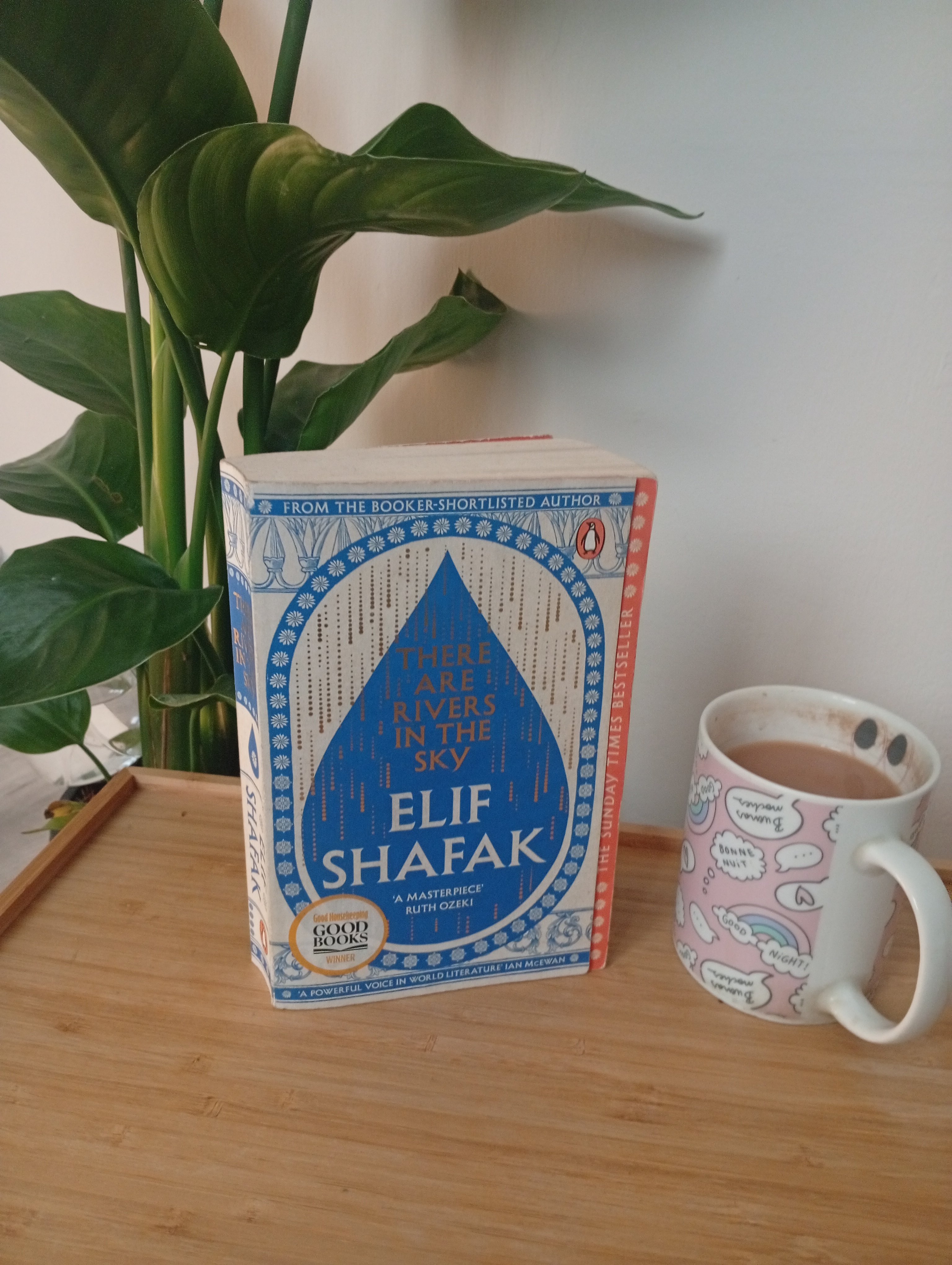
Welcome to the Last Cross Book Club. Each month, we choose a book for our readers to discover and discuss together.
Author - Elif Shafak
Year of Publication - 2024
The inaugural novel for the Last Cross Book Club was chosen by yours truly and wasn’t easy to pick. Our current membership, including myself, can be tricky customers. We have decided to take an egalitarian approach to our little gatherings, with people choosing the books on a rotating basis and then perhaps voting for our favourite at the end of the year, no pressure for the first one then!
There are Rivers in the Sky appealed to me for many reasons. On a slightly shallow level, the cover art and name are instantly intriguing, it certainly stands out on the shelf. The clincher, however, was how much the story seemed to resemble something written by Khaled Hosseini, my all-time favourite author. Hosseini’s style of combining various time frames, informative historical elements, geopolitical conflict, and very plausible stories of mundane misfortune and hope were all present in the summaries that I read about Rivers and I ultimately couldn’t resist.
We begin with an introduction to Assyrian king Ashurbanipal in Nineveh, and wind our way through London and the Middle East with the stories of three complex characters. Two strong-willed heroines and one unlikely hero come together to form the allegorical H₂O structure which underpins the entire narrative.
Shafak weaves skillfully through centuries and locations, from the palace of Ashurbanipal in ‘Olden Times’, to a tattoo parlour in modern-day London. The most emotional storyline, though, concerns the persecution of the Yazidi people, seen through the eyes of a young girl, our first H₂O molecule, Narin. I have said before that I don’t much go for books which are academically weighty, with more information than actual narrative. However, I also believe that the best books are capable of teaching the reader something, those that inform and create empathy for the characters. In this case, Narin’s story is a fabrication but could very easily be true of a real-life young girl from a similar community, such is the violent and terrible nature of Yazidi persecution throughout history. The storyline puts a devastatingly plausible face on human tragedy, and attempts to educate on the historical and cultural reasons for it.
The second molecule in our story introduces Arthur, a reimagining of much revered Assyriologist George Smith, hired by the British Museum to study and translate the cuneiform tablets upon which The Epic of Gilgamesh was discovered. In my view, the author took a risk with this character, taking myriad liberties with what we know of the real George Smith. The inherent problem with including real-life individuals in fiction, especially as reimagined versions of themselves, is the risk of either botching the history or turning them into something they weren’t in an attempt to make the story work. Both of these pitfalls, in my view, represent a potentially enormous disservice to the original figure. In Rivers, Shafak seems to have successfully avoided doing this and Arthur is an extraordinarily likeable addition to the book. His Dickensian upbringing and struggle to the very top of his profession provide a deeply cathartic element to the story and make his untimely death intensely sad.
My fellow book club members and I largely agreed upon the virtues of the novel. We all found the pervading plot device of water quite clever, the historical hints and lessons very interesting, and the pacing overall very well crafted. That being said, most of us also reached the conclusion that there was too much ground to cover in 482 pages, a few too many loose ends and unfinished tangents that could perhaps have been explored in a little more depth. Case in point, the book ends relatively abruptly, without following up on the budding relationship between our final molecule Zaleekhah and her tattoo artist beau. We also don’t get to see the novel’s final antagonist, Zaleekhah’s uncle, punished for his attempted dealings in black market organ trafficking. Frustratingly, these are things that the reader is left to ponder.
Shafak’s ambitious choice of subject matter pays off to a large extent. It is no small feat to blend history, folklore, conflict, loss, love, tragedy and hope, even having room left over to educate the reader and inspire an interest in some of the story’s plot points. Incidentally, I am much better informed about the culverted rivers that exist under and around my part of the world, the history and plot of The Epic of Gilgamesh, as well as the awful plight of the Yazidi people. Despite the loose ends and occasionally far-fetched creative licence taken with the portrayal of water and its properties, There are Rivers in the Sky is well worth a read.
On a final note, I highly recommend watching the conversation between author Elif Shafak and Classicist Mary Beard, in which they discuss the novel’s themes at the British Musuem.
Have a butcher’s - https://www.youtube.com/watch?v=BfbsYGj4hHw
Join the Discussion
Have something to say about this book? Share your thoughts, questions and opinions in the comments below.
Leave a comment
Have something to say about this article? We'd love to hear from you. Comments are reviewed before they appear on the site.